Saturday, April 6, 2024

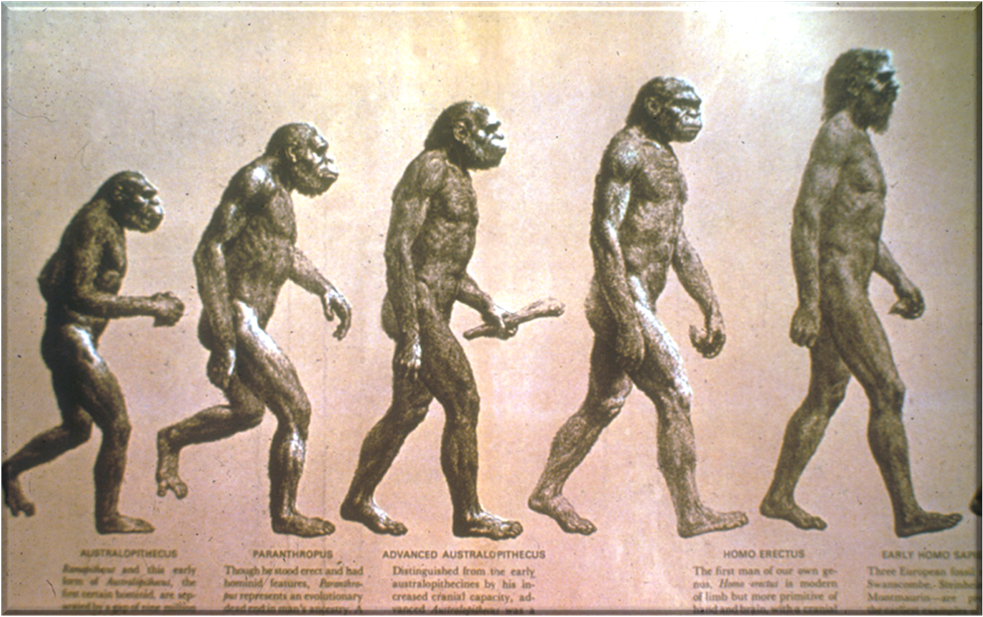
JAVA MAN, THE MISSING LINK?


Science Magazine – “Fossil evidence reveals that members of Homo erectus on Java… may have persisted on the island until about 100,000 years ago”.


The main thing I want to address in this article is what the so-called “fossil evidence reveals” about the previously named, “Java Man”.  The term is based on the location of the discovery, Java Indonesia.  The term was later changed to Homo Erectus or “upright man”.  One of Haeckel's students, Eugene Dubois, became determined to find Pithecanthropus.  Haeckel believed men might have separated from apes somewhere in Southern Asia.  So, in 1887, Dubois signed up as a doctor with the Dutch medical corps in the Dutch East Indies (now Indonesia), intending to hunt for fossils during all his spare time.  Dubois, it should be noted, had no formal training in geology or paleontology at the time, and his "archaeological team" consisted of prison convicts with two army corporals as supervisors. Years of excavation produced little of significance. Then, in 1891, along Java's Solo River, the laborers dug up a skullcap that appeared rather apelike, with a low forehead and large eyebrow ridges.  Dubois initially considered it from a chimpanzee, even though there is no evidence that this ape ever lived in Asia.  However, the following year, the diggers unearthed three human teeth and a thigh bone that was clearly human.  Dubois, like Piltdown's discoverers, presumed that an apelike bone somewhere near a human bone meant the two belonged to the same creature, constituting Darwin's missing link.  

     In 1895, Dubois returned to Europe and displayed his fossils. The response from experts was mixed, however. Rudolph Virchow, who had once been Haeckel's professor and is regarded as the father of modern pathology, said: "In my opinion, this creature was an animal, a giant gibbon, in fact. The thigh bone has not the slightest connection with the skull." The circumstances of Dubois' find were unorthodox. He had apparently been absent when the convicts dug up his fossils. Maps and diagrams of the site were not made until after the excavation. Under such conditions, a modern dig would be disregarded.

     In 1907, an expedition of German scientists from various disciplines, led by Professor M. Lenore Selenka, traveled to Java seeking more clues to man's ancestry in the region of Dubois' discovery. However, no evidence for Pithecanthropus was found. In the stratum of Dubois' find, the scientists found hearths and flora and fauna that looked rather modern. The expedition's report also noted a nearby volcano that caused periodic flooding in the area. Java Man had been found in volcanic sediments. The report observed that the chemical nature of those sediments, not ancient age, probably caused the fossilization of Pithecanthropus. Nevertheless, the Selenka findings and various deficiencies of Dubois' work were largely ignored, and Java Man became one of evolution's undisputed "facts."

     Fossil evidence is used to determine age by means of radiometric dating.  The practice involves determining the quantity of C-14 (Carbon) remaining in the fossil itself.  This method of radiometric dating is primarily used to determine the age of previously living organic material.

     When cosmic radiation strikes the Earth’s atmosphere it converts N-14 (Nitrogen) into C-14 which is consumed by the fauna by means of inhalation and consumption.  When an organism expires the amount of C-14 begins to decay.  The half-life of C-14 is determined to be at 5,730 years, as a result measurable amounts of C-14 are undetectable beyond 50,000 years.  This article claims that Homo erectus existed on Java “until about 100,000 years ago”.  This number could not have been arrived at by means of C-14 dating.  So, what method of radiometric dating was employed to determine an age of 100,000 years+?  That information was not relayed at any point in the article.  All that is stated in the article is that “the researchers applied five types of radiometric dating” but they do not say what those “types” were.  Furthermore, the article also stated that a “new method” of dating was applied, but again it does not state what that “new method” of radiometric dating was.  Only that it was applied “to those animal fossils and the sediments around them” (emphasis added). 

     But what method of radiometric dating was used for measuring those sediments?  They could have applied any number of differing dating techniques, Polonium/Lead, Potassium/Argon, Rubidium/Strontium or something different.  But all dating methods are highly subjective as they are capable of yielding wide ranging discordant results in the ages given.  This process is achieved by means of measuring the ratio of parent to daughter elements in a given sample, for example, the parent element of Po-218 (Polonium) decays into the daughter element Pb-214 (Lead) with an extremely short half-life of just three minutes.  As such, the parent element Po-218 should be completely absent from any rock formations, and yet they appear in the trillions inside granite, believed to be the “basement” or “first formed” rock after the Earth had supposedly cooled for millions of years.  The existence of these radio polonium halos, however, suggest that those granite rocks were solid inside of three minutes, anything longer would indicate that those polonium halos should not be there, but they are.  Furthermore, if you melt granite, when it solidifies it becomes rhyolite, not granite.  This suggests that granite was never in a molten state.

     Potassium/Argon dating is one of the most popular forms of radiometric dating as it is the least labour intensive, and the most affordable form of dating used.  K-40 is the parent element of Ar-40, which is the daughter element that potassium decays into.  This method of dating typically yields a half-life of 1.25 billion years.  Potassium/Argon dating is primarily used to date igneous and fossil bearing rock strata.  This is a possible dating method that may have been employed to date the fossils at Java.  Remember though, in this method it is not the fossils themselves which are dated, but the sediments surrounding the fossils.  From there it is assumed the fossils are of the same age as the sediments in which they are discovered, a tautology of reasoning.  It cannot be denied that from a strictly philosophical standpoint geologists are here arguing in a circle. The succession of organisms has been determined by a study of their remains embedded in the rocks, and the relative ages of the rocks are determined by the remains of organisms that they contain.[i]  In the American Journal of Science J. E. O’ Rourke stated that, “Radiometric dating would not have been feasible if the geologic column had not been erected first.”[ii]  I’m not sure O’Rourke recognized the gravity of the statement he made.  The geologic column was first proposed by Scottish lawyer and geologist Charles Lyell in the early part of the 19th century.  

     Charles Lyell viewed the rock strata and divided those strata into three broad eras, Paleozoic, Mesozoic and Cenozoic.  “Paleo” means “old” or “ancient”.  “Zoe” is the word for “life” therefore “Paleozoic” means “old” or “Ancient Life”.  “Meso” means “middle” so “Mesozoic” means “Middle Life”.  “Ceno” means “new” or “recent” therefore “Cenozoic” means “Recent Life”.  In order to determine the age of each of the rock layers he could not rely on any form of radiometric dating such as uranium-lead, potassium-argon or rubidium-strontium dating method as they had not yet been discovered.  Instead, he determined the age of the layers based on the fossils.  If the layers contained fossils of organisms currently living then those layers were determined to be younger, if the layers contained fossils of organisms no longer living then those layers were determined to be older.  Lyell borrowed the ideas of Scottish scientist James Hutton who advanced the notion of uniformitarianism contrary to the more prominent catastrophism to explain the various sedimentary layers observed.  The mantra of uniformitarianism was that “the present is the key to the past”.  In other words, present gradual geological processes of erosion and vulcanism, for example, have always remained the same.  From this observation, Lyell determined what the dates of the geologic column should be.

     The parent element of Rb-87 (Rubidium) decays into the daughter element Sr-87 (Strontium) with a widely varying half-life of 48.8 billion to 120 billion years.  A variation of 146%.  This method of dating is often employed to date Igneous rock and Metamorphic rock.  This method of radioactive dating was the first extensively used dating method which employed the isochron method.  The term “isochron” means, “equal time”; it is a graph which is utilized to address some of the radiometric dating issues.  The first attempts to answer the question of whether or not any daughter elements were present in the sample when it first solidified.  If there were, then this will affect the final results leaving a misleading age for the sample.  The second attempts to determine if the sample has remained in a closed system throughout its history.  If not, mineral atoms can migrate into or out of the sample invalidating any test results for age.       

     Regardless of whether or not this article provides the method of dating used or not, all dating methods are subjected to a number of assumptions which invalidate the results.  It is due to those built-in assumptions which invalidates the aforementioned isochron method for dating rock samples.  In the hourglass analogy we have a closed system, nothing gets in or out.  The upper half of the hourglass represents the parent element, the bottom half represents what the parent element decays into, referred to as the daughter element. But if I could remove one end of the hourglass and add more sand to it, or remove some of the sand from it, that would affect the time it takes to fall to the bottom.  Furthermore, if I were to excuse a group of students from the class before turning it over.  When I brought them back in, would they be able to determine how long the sand in the hourglass had been falling?  If it was a two-minute hourglass and I brought them back in after a minute, there should be an equal amount top and bottom.  But what if I did not bother turning the hourglass over until 45 seconds into the first minute of that two-minute timer?  There are too many variables and assumptions in the dating of rock samples that make determining their respective ages virtually impossible.   

     Finally, terms like “probably”, “could have” and “may have” that appear in the article indicate a level of subjectivity and conditional possibility, in contrast to terms like “is” and “are” which are a present indicative.  As such, there appears to be a lot of conjecture regarding what the findings actually indicate.


[i] R.H. Rastall. “Geology” Encyclopedia Britannica, Vol. 10 (1949) p.168.

[ii] J.E. O’Rourke. “Pragmatism versus Materialism in Stratigraphy,” American Journal of Science, vol. 276 (January 1976), p. 54.

https://www.sciencemag.org/news/2019/12/ancient-human-species-made-last-stand-100000-years-ago-indonesian-island 

Saturday, March 30, 2024


INTO THE VOID

The Crown – Moondust S3 Ep7

In an episode of The Crown from season three entitled “Moondust”, Prince Philip was facing something of a crisis of faith or at least an internal struggle as he searched for meaning and purpose. This he believed was accomplished through great acts. The antecedent of this search may be a result of the passing of Prince Philips’s mother portrayed in episode six, and who had admonished Philip to “find your faith”. He found himself affixed and inspired by news coverage of the Apollo moon landing in July of 1969. "Great accomplishments such as these give a man a sense of purpose, and to life, meaning, not the simple navel gazing of Philosophers and Theologians" which he feels accomplishes nothing of any great value.

     Prince Philip had felt that attending church every Sunday had become "tedious and a waste of time," at which point he determined to "spend that hour being more productive." The Queen undertook to search for a new minister. The new minister paid a visit to Prince Philip with a request to utilize one of the vacant buildings at Windsor Castle as an academy for spiritual growth.  In general, the new minister stated that, “you get to a certain age when you hit a ceiling, a crisis, you lose perspective, the same is true of clergymen”. So, the academy would be for clergymen to recharge, reflect, “to improve their game”. Prince Philip inquired as to how exactly this would be accomplished. The new minister replied, “talking, thinking”.  Whereupon Prince Philip stated that his whole approach was flawed, arguing “You don’t raise your game by talking or thinking, you raise your game through action”.  At which point the prince references the accomplishments of the men of the Apollo moon landing. 

     Nevertheless, at the request of the new minister, Prince Philip reluctantly accepted his invitation to speak to the group of clergymen who had gathered. His comments to them were less than flattering. He accused them of being "pretentious, full of self-pity," essentially "catatonic," arguing that “action is what defines us” and to "get out there and do something." Again, he uses the astronauts of the Apollo moon landing as an example. They were out there doing something, not "sitting around like a bunch of naval gazing, under achievers infecting one another with gaseous doom."     

     For the momentous accomplishment, the astronauts of the Apollo moon landing, Neil Armstrong, Michael Collins, and “Buzz” Aldrin, were invited by the Queen of England, to visit Buckingham Palace. Prince Philip requested a private audience with the astronauts in hopes of learning what insights, if any, the three men may have discovered on their voyage and what walking on the moon was actually like, nothing of any significance was realized as the result of the venture. Surely there must have been something after so great an accomplishment, but there was nothing. No deep insights, no profound contemplation of the universe and our place in it, nothing.  

     Dejected, Prince Philip returned to speak with the clergymen and confessed that the astronauts with whom he spoke found no sense of fulfillment in what they had achieved. He confessed to them that he was in something of a crisis, admitting that during such times people will resort to different things to deal with that crisis. At which point he mentioned his mother’s passing stating that, “she saw that something was amiss” in him – that something was missing, “faith”. He admitted to them that he had lost it. Some, writing on this same episode, have argued that Prince Philip was going through a mid-life crisis. I believe there was something more going on, and Prince Philip said as much, it was a crisis of faith. Regarding faith he stated simply, “without it, what is there?”. He goes on, “the answer is not in science or achievement, it’s wherever faith resides, the head or the heart”. He had come to those clergymen that time with respect and admiration and “in desperation to ask for help, help me”.

     Blaise Pascal has made reference to “a God-shaped vacuum” or void, which exists in each of us.  Into which we are prone to pour whatever we can find to fill it and satisfy our restlessness, as Prince Philip himself observed. Augustine of Hippo has stated, “Thou hast formed us for Thyself, and our hearts are restless till they find rest in Thee”.[i]

      It comes to all people sooner or later, the larger questions of life and its meaning, and what happens when this life is over. These questions are asked by princes and paupers alike. In that respect, the Duke of Edinburgh was not alone.   

In memory of His Royal Highness Prince Philip 1921 – 2021.


[i] Augustine of Hippo, “The Confessions of St. Augustin,” in The Confessions and Letters of St. Augustin with a Sketch of His Life and Work, ed. Philip Schaff, trans. J. G. Pilkington, vol. 1, A Select Library of the Nicene and Post-Nicene Fathers of the Christian Church, First Series (Buffalo, NY: Christian Literature Company, 1886), 45.


Saturday, March 23, 2024

LEX LUTHOR AND THE PROBLEM OF EVIL: A THEODICY


In the movie, Batman V. Superman Lex Luthor put forward an explicit argument on the character of God,

     “What we call God, depends upon our tribe…Because God is tribal, God takes sides. No man in the sky intervened when I was a boy to deliver me from daddy’s fist and abominations. I figured out way back, if God is all-powerful then He cannot be all-good, and if He is all-good, then He cannot be all-powerful.” Lex Luthor – Batman v. Superman

     This type of argument against the existence of God is commonly referred to as the problem of evil. It is not a new problem; it actually has a rather lengthy history. Typically, Epicurus (341-270 B.C.) has been credited with formulating what has been referred to as the Epicurean Paradox, but it was Scottish Philosopher David Hume who popularized it. His version of the argument is stated in the following way,

"Is he [God] willing to prevent evil, but not able? then is he impotent. Is he able, but not willing? then is he malevolent. Is he both able and willing? whence then is evil?"

     The first question I would ask is, how did Lex Luthor know that his father’s actions against him were evil? Why does he come to that conclusion? Could it be that Lex Luther has an innate sense of what is right or wrong? That certain evils perpetrated are not arbitrary or subjective, but that objective morality does in fact exist? That certain acts of evil exist regardless of time, location, occasion, or circumstance? 

     If objective moral values exist, then God exists. If objective moral values do not exist, then God does not exist. Objective moral values do exist therefore, God does exist. If we are going to claim that objective morality does not exist, and that morality only exists subjectively then Hitler did nothing wrong, he was simply doing what he believed was right. Ergo, Luther’s father did nothing wrong in beating him as a child. But if we know that to perform an act of genocide on a group of people in an effort to obliterate them, or to beat and sexually abuse a child is abhorrently wrong, then we know that certain evils are objectively wrong and that therefore objective morality does exist.

     God is perfect in existence in the absolute, as such, He can do nothing which is contrary to His own nature. God is light, and in him is no darkness at all (1 Jn. 1:5). While God is omnipotent, there are some things that He cannot do, He cannot sin, He cannot be tempted, He cannot deny (contradict) Himself, He cannot lie, for God cannot be tempted with evil, and he himself tempts no one (James 1:13b). He may test an individual, but He will not tempt anyone. Evil acts are the out workings of a sinful nature. Evil is extraneous, sin is constitutional, evil is an effect and sin is its efficient cause. This article will come in two parts, in the first part I will address the doctrine of sin, in the second part I will address the more philosophical problem of evil.

Part One: The Doctrine of Sin

     The philosophical problem of evil is predicated on the theological doctrine of sin or hamartiology, derived from the Greek word, hamartia, meaning, “to miss the mark”. In theological circles it is referred to as the doctrine of “original sin”. Original sin is a term referring to the universal defect in human nature caused by the fall, entailing the loss of original righteousness and the distortion of the image of God (imago Dei) [i] in man.

 1.     Man in the Image of God

     The world as it is, “red in tooth and claw”, is not the way God originally created it when He pronounced it “very good”. In the Genesis account of creation, the Hebrew adjective, ṭôḇ is translated as “good” six times. This Hebrew word has been translated a number of different ways, “good” is one way, but also as “appropriate” and “excellent”. He certainly would not create anything that was not excellent, or which was inappropriate, even if He could do it He would not do it as it would be contrary to His nature to do so.

     In Genesis 1:31 the writer uses a double adjective to express the state of God’s completed creation, “very good”. All that God had made was not just “good” it was “very good”, me‘ôḏ meaning vehemently, exceedingly, or exceedingly great to a high degree.  Everything that God had created was not only excellent (or ṭôḇ) it was exceedingly excellent (me‘ôḏ ṭôḇ) , or great, to a high degree. The creation of man would have been no less excellent.

     Then God said, “Let us make man in our image, after our likeness. And let them have dominion over the fish of the sea and over the birds of the heavens and over the livestock and over all the earth and over every creeping thing that creeps on the earth.” (Gen. 1:26).

     Differences of opinion respecting the likeness of man to God early appeared in Christian thought. With a common agreement that man himself was the image of God, there was still the cardinal question as to what really constituted man. Some could not dispense with the body as an essential part, and therefore assumed for it a likeness to God. This required the assumption of some form of corporeity in God; for it is not to be thought that a physical nature can bear the likeness of a purely spiritual being. [ii]

     This idea that man’s “likeness” to God or having been “created in the image of God”, inferred some corporeal similitude with God never gained widespread acceptance. Rather, the predominant view was that being “created in the image of God” meant that he was like God in his spiritual nature, not in his physical make up. Contrary to some New Age thinkers who believe that we are God.

     There seems to have been some rather divisive discussion over the years regarding the question of the words, “image” and “likeness” and their respective meaning. Whether their meaning is different, or if the two words serve jointly to express a singular notion. Some church fathers including Irenaeus, Clement of Alexandria, and Origen believed that these two words possessed distinctive meanings. Such a view is utterly discredited by the fact that this likeness of man to God was an original creation, not any subsequent attainment through either the free agency of man or the sovereignty of divine grace. A distinction of meanings in the two original terms is again discredited by the fact that in other places only one is used, sometimes one and sometimes the other, and in a manner to give to each the full meaning of both in the primary instance of their conjunct use. [iii]

     The words “image” and “likeness” are derived from two Hebrew words, ṣelem; LXX εἰκών; Lat. imago) and “likeness” (Heb. d’mûth; LXX ὁμοίωσις; Lat. similitudo).[iv] Selem or image is utilized seventeen times in the Old Testament, four of those occurrences are found in Genesis. The four times the word is used in Genesis occurs as part of the phrase, “image of God”. Of the thirteen times the word is used outside the book of Genesis, six are in reference to idols, three refer to the “physical representation” of tumors and rats, two are in reference to something transitory, one is in reference to a painting, and the last is in reference to Seth being in the image of Adam. The Hebrew for image (selem) comes from a root word meaning “to cut” or “hew”, so typically the reference is in the physical sense, though selem can refer to things which are intangible which is not unreasonable as the definition implies such things as man’s ability to contemplate the meaning of life and his own mortality. The ability to conduct himself rationally, or irrationally. To conduct himself morally or to contemplate the consequences of his immorality, the ability to reason or act volitionally and so on.

     The “likeness” of man to God was constituted in the fact that God is a spirit (Jn. 4:24), while physical in makeup man is also a spiritual being and is therefore relatable to God on that level. Furthermore, man is moral in nature, possessing a sense of duty and obligation, right and wrong, as previously noted, which tends toward the moral argument for God’s existence. There is within man’s being created in the image of God, the sense of implicit holiness as born out in the life of the regenerate, a recreation of fallen man back to the image of God once again, whose image though defaced by sin was not erased by it. Jonathan Edwards has stated that,

Adam was brought into existence capable of acting immediately, as a moral agent, and therefore he was immediately under a rule of right action; he was obliged as soon as he existed to act right. And if he was obliged to act right as soon as he existed, he was obliged even then to be inclined to act right.… And as he was obliged to act right from the first moment of his existence, and did do so till he sinned in the affair of the forbidden fruit, he must have had an inclination or disposition of heart to do right the first moment of his existence; and that is the same as to be created or brought into existence, with an inclination, or, which is the same thing, a virtuous and holy disposition of heart.” [v]

     Theologian John Miley appears to contest Edwards’ view that Adam was “obliged” to “act right” when no act of duty was yet pending on his person. Perhaps, but Adam was created in the image of God, implicit within that creation was a holy disposition on the part of Adam who, therefore, would at least have been “inclined to act right” though not, as yet, having the occasion to do so. Though doubtful of Edwards view Miley recognizes that, “There may be holiness of the moral nature previous to free moral action…Whatever it might become by good conduct, such it might be constituted in its original creation”. [vi] Furthermore, Miley recognized that a moral nature must have moral tendencies. [vii]

 2.     The Origin of Sin

     Biblical history is divided by dispensations, the “dispensation of innocence” is the time frame of the creation of man which extends to the time of the fall of the same (Genesis 1-3). Biblical history may also be divided by covenants; this same time frame, under covenant theology, has been referred to as “the covenant of works”, though some have argued that there is no explicit evidence from the text that any such covenant existed as the Hebrew word for covenant, ḇerîyṯ (ber-eeth'), can be located nowhere in the text of the creation account.  That being said, many will concede, at least, a probationary period is very possible, but not necessarily as a covenant per se.

     There is no injustice here on the part of God in implementing a period of testing, human depravity is a consequence of man’s sin. What would constitute an injustice would be if God had instituted a probationary period for man without man’s having the ability to perform it in the way he ought to as a moral duty. As Geisler has noted, “there can be no response-ability without the ability to respond.” [viii]

     If God had so desired that man should be obedient, happy, and to conduct himself after a holy manner, then He must have endowed him with such power and ability so as to perform it. Therefore, they must have possessed the power of obedience as a divine endowment. There can be no testing of fidelity under a law of duty where there is not the power of obedience. [ix]

     Theologian Henry Orton Wiley held that this probation period was necessary and that as such God permitted their temptation. While I agree with the former, I would contest the latter. What God was willing to permit was a period of testing which, as a result, could lead to one’s being tempted. But being tempted is not the problem submitting to it is, which was a possibility given that they were created as free creatures. Nevertheless, they still possessed within themselves “the power of obedience”. Likewise, Miley contended that God permitted “the Adamic fall”. This, as in the former is, I believe, contestable on the same grounds as I have made regarding Wiley’s position. God was not permitting their temptation or the fall of the race, as Miley has indicated, obedience to His instruction was preferable. What God did permit was their testing; probation is a temporal, testing economy. There is a law of duty, with the sanction of rewards.  The essential fact of probation under a testing law of duty is moral responsibility. [x]

     God is free, being free He is able to choose whether to create or not to create. As He has chosen to create, He must therefore create that which is perfect, He must create the “best possible world”, it would be contrary to His nature to do otherwise. A perfect being, such as He is, must create that which is perfect, therefore Adam and Eve were created as perfect. How can a perfect Adam or a perfect Eve be capable of committing an act of sin? As God is free, a perfect world must include in it creatures which are themselves free. Possessing free-will and the ability to choose means, however, the ability to choose otherwise, or to choose contrary to God’s will. We are moral creatures possessing free-will and a sense of duty, as such a period of testing is necessary. A being personally constituted and endowed with free moral agency must be under law to God, and responsible for his conduct. [xi]

     The nature of free-will could either be deterministic, in-deterministic, or self-deterministic. Determinism can come in two forms, soft or hard determinism. Soft determinism holds that human free-will is under God’s control. In hard determinism there is no free-will. Indeterminism takes the neutral position that human acts are not caused by anything. Self-determinism holds that free-will acts are self-caused. As for determinism, God did not cause Adam to sin, for, again, God can neither sin nor tempt anyone else to do so. Neither did Satan cause Adam to sin, for the tempter did only what his name implies, neither forcing him to do it nor doing it for him. As for indeterminism, there was not evil (or lack of wholeness) in Adam’s nature that gave rise to his sin, for he had none – God created him perfect. And there are no uncaused actions; this would violate the principle of causality. [xii] Geisler has stated that,

Adam… must have caused it himself; Adam’s choice was self-determined. This is the heart of human freedom; namely, the ability to be the efficient cause of one’s own moral actions. Acts of which one is not the efficient cause, but rather which are forced, are not free moral acts.” [xiii]  

     When Adam partakes of the fruit in Genesis 3, the most severe charge brought against God is not that he caused Adam to sin, but that in making Adam significantly free God brought about the possibility that Adam might misappropriate his freedom and choose a course of action that is morally wrong. God is not responsible for Adam’s choices given that Adam was endowed in creation with self-determining free will. [xiv]

     The object of their testing lay in the tree of the knowledge of good and evil and God’s express instruction not to eat of it, therefore a choice for creatures of free-will, either to obey the word of God or to follow the lie of the serpent existed. Obedience would have resulted in reward, by extension disobedience would have resulted in punishment. In terms of the punitive punishments of sin, physical, spiritual, and possible eternal death ensued. In addition, human depravity is the result of a deprivation. When man sinned, he lost the moral image of God in which he had been created. This meant that the Holy Ghost withdrew from his being, and man lost his state of primitive holiness. The result of this deprivation or loss was that the tide of sin flowed in upon man, overflowing his whole nature. The controlling, enabling, sanctifying power of the Holy Spirit being lost, man became estranged from God, enslaved to irregular impulses and evil passions. [xv]

     Man’s whole nature was affected as a result of sin. Having the freedom to choose is a good thing, however, it is possible that such freedom could be misused. God is responsible for the creation of free-will creatures such as we are. Man is responsible for the misuse of that freedom. “For from within, out of the heart of man, come evil thoughts, sexual immorality, theft, murder, adultery, coveting, wickedness, deceit, sensuality, envy, slander, pride, foolishness”. (Mark 7:21-22).

     The total depravity of our human nature has resulted from Adam’s acting as federal head of the entire race. Such depravity was imputed, though the race did not exist at the time of Adam’s transgressing, yet existing in him potentially, we all receive the curse and stand guilty. Such total depravity intimates inability to achieve by our own striving any form of absolution from such guilt. Our depravity, reprehensible as it is, does not indicate an inability to receive from God that which He graciously offers, forgiveness.  

     So, what does all this have to do with Alexander (Lex) Luthor? We are not sinners because we sin, we sin because we are sinners. To claim the former would indicate that all are innocent up to and until a transgression is actualized, but this runs contrary to scripture. Scripture actually purports the latter, that we sin because we are sinners by nature. The reason Luthor, his father, and we ourselves, do what we do merely shows that we are sinners already. God cannot be implicated; we act in accordance with our own free-will to do right or not. We commit acts of sin by commission, doing what we know we ought not do, and sins of omission, not doing those things we know we should do. The apostle Paul not only recognized the problem in himself, but also its solution. Romans 7:15-25.

     This article has been built around two premises, (1) that God is wholly perfect in existence and existing as a perfect being with total freedom it is impossible that He should create anything imperfect. That man being created in the image and likeness of God was perfect in existence possessing a holy disposition, and was created as a free moral agent, with the ability and freedom to choose. (2) That Adam acting as federal head of the race did of his own volition enact his own will contrary to the will of God bringing sin into the world and death as its consequent. Thus, leading to the conclusion that God cannot be held to account for sin’s origin and the suffering that has resulted from it. 


[i] Hay, A. (2016). Original Sin. In J. D. Barry, D. Bomar, D. R. Brown, R. Klippenstein, D. Mangum, C. Sinclair Wolcott, … W. Widder (Eds.), The Lexham Bible Dictionary. Bellingham, WA: Lexham Press.

 [ii] Miley, J. (1892). Systematic Theology, Volume 1 (p. 406). New York: Hunt & Eaton.

[iii] Ibid., 406–7

[iv] Ryle, H. E. (1921). The Book of Genesis in the Revised Version with Introduction and Notes (p. 20). Cambridge: Cambridge University Press.

[v] Miley, J. (1892). Systematic Theology, Volume 1 (p. 411). Quoting Edwards: Works, vol. ii, p. 385. New York: Hunt & Eaton.

[vi] Ibid., 412. 

[vii] Ibid., 434.

[viii] Geisler, Norman. (2004). Systematic Theology: Vol. 3 (p. 86). Bloomington, MI: Bethany House Publishers.

[ix] Miley, J. (1892). Systematic Theology, Volume 1 (pp. 433–434). New York: Hunt & Eaton.

[x] Ibid., 437.

[xi] Ibid.

 [xii] Geisler, Norman. Systematic Theology: Vol. 3 (Bloomington, MI: Bethany House Publishers, 2004), p. 86.

[xiii] Ibid.

[xiv]   Evans, Jeremy A.. The Problem of Evil: The Challenge to Essential Christian Beliefs (B&h Studies in Christian Apologetics) (p. 9). B&H Publishing Group. Kindle Edition

[xv] Wiley, H. Orton. (1946). Introduction to Christian Theology, (p. 177). Kansas City, Mo.: Beacon Hill Press.

Friday, March 22, 2024

GOD AND THE GUARDIAN OF FOREVER


In an episode of the original Star Trek series entitled “The City on the Edge of Forever” Captain Kirk and Mr. Spock discover a “time machine” or portal as it were that would allow them to pass through it and into the past. Their purpose for doing so was to rescue McCoy after he passed through the portal under the influence of a self- induced injection. He had inadvertently emptied a syringe into his system which affected his neurological functioning causing him to hallucinate. In order to rescue him Kirk and Spock needed to travel back in time before McCoy injected himself. 

     This “time machine” or portal possessed the ability to communicate with Kirk and Spock. The ensuing dialogue between the three resulted in Kirk enquiring “Are you machine or being?” The “Guardian of Forever” replied, “I am both and neither. I am my own beginning, my own ending”. For our purposes we could phrase Kirk’s question as follows, “Do you exist contingently or necessarily”? This two-letter word “or” that Kirk uses is a very important one. It is indicative of a contrast between two opposing realities and only two. Those things which exist only exist in one of two ways, either they exist by their own nature, of their own accord, (necessarily) or they exist as a result of something or someone else bringing them into existence (contingently). The Guardian’s reply that it is, “both and neither” contains a contradiction. That word “and” is a conjunction implying that its existence is not one or the other but that it exists both contingently and necessarily. But this is impossible as it violates a number of laws of logic including the law of non-contradiction. The law of non-contradiction states that you can’t not have A and yet have A in the same sense to the same extent. So, the Guardian could not be both machine and being and at the same time be neither machine nor being. 

     Furthermore, this statement also violates the law of excluded middle, also known as the law of excluded third from the Latin principium tertii exclusi or more directly tertium non datur meaning “no third (possibility) is given”1 (emphasis added). Kirk has phrased the question of the Guardian’s existence correctly, “are you machine OR being” (emphasis mine). Kirk, or at least those who wrote the dialogue for this scene, realizes that the answer to the question must be one or the other, there is no third option. But the authors of this dialogue also seem to think that there could be a third option as the Guardian states, “I am both and neither”. Even though the task of the Enterprise is “to seek out new life forms” it is a logical absurdity that anything could exist both contingently and necessarily.  That which exists contingently is caused by something external to itself, it is as Aquinas has noted that things which exist contingently “are possible to be and not to be,”2. In other words, it is possible for them to not exist. The same could not be said of that which exists necessarily for anything which exists necessarily does so of itself. It is impossible for that which exists necessarily to not exist. Abstract objects such as shapes and numbers are said to exist in this fashion, that is, necessarily.

     Finally, this statement also violates the law of bivalence. In the law of bivalence every proposition made is either true or false. Thus, the answer the Guardian provides “I am both and neither” is either true or false regarding the way in which it exists.  The problem is that the proposition contains a contradiction, as I have already noted, and as such the statement “I am both and neither” is false because, as I have shown, nothing in existence can exist contingently and necessarily, it must be one or the other.

     Furthermore, the Guardian seems to ascribe to it own Aseity in stating, “I am my own beginning, my own ending”. The word “aseity” comes from the Latin a se meaning from, or of oneself. In other words, the Guardian is stating that it exists in and by itself, that it has the power of being (or existence) within itself, a corollary of which is that it exists necessarily. However, when Kirk enquired as to whether or not the Guardian could “change the speed at which yesterday passes?”  the Guardian replied, “I was made to offer the past in this manner, I cannot change”. (Emphasis added). 

     Curious, now the Guardian has contradicted itself indicating that its existence is contingent.  Remember, nothing which exists can do so both contingently and necessarily. How can the Guardian’s existence be predicated on a maker, or makers, and at the same time exist in and of itself?  It cannot be both created and be self-existing at the same time. By contrast, the Judeo-Christian concept of God is that He exists in and of Himself necessarily.  As a necessarily existing being, God’s non-existence becomes impossible, His existence is essential, and existence is the essence of His being, He cannot not exist.  Aquinas has stated,

     Now it is impossible for a thing's existence to be caused by its essential constituent principles, for nothing can be the sufficient cause of its own existence, if its existence is caused. Therefore, that thing, whose existence differs from its essence, must have its existence caused by another. But this cannot be true of God, because we call God the first efficient cause. Therefore, it is impossible that in God His existence should differ from His essence.3

In other words, if the essence of a thing differs from its existence, then its existence must be based contingently. By contrast, if the essence of a thing is intrinsic with its existence, then that thing must exist necessarily. 

     In the ensuing dialogue that God had with Moses in Exodus 3:14 He identified Himself by the name of YHWY (Yahweh) from the Hebrew root verb hayah meaning, to be, self-existent, or eternal. The proper name “Yahweh” has suggested to scholars a range of likely nuances of meaning including, but not limited to, that He is a non-dependent, self-existing Being; that He is immutable with respect to His Being and character and as such lacks all potentiality, and that He exists eternally. The proper name Yahweh signifies both his eternity (“I Am”) and his unchangeableness (“that I Am”). The former denotes the duration of the divine essence without beginning, without end, and without succession. The latter signifies that God’s essence, perfections, purpose, and promises endure eternally without any variation.4

     To summarize, anything which exists can only exist in one of two ways, either contingently or necessarily.  It is not possible that The Guardian’s existence should be predicated on a creator, and therefore exist contingently, and at the same time exist necessarily. Even God does not exist in this fashion.  Anything which exists contingently (The Guardian) indicates that its non-existence is possible, and if that is so then it cannot exist necessarily as something which exists necessarily (God) indicates that its non-existence is impossible.  Furthermore, it is not possible for a contingent being, such as The Guardian, to exist a se at the same time.  By contrast, intrinsic to the nature of God is the way in which He exists (a se), in and of Himself, the uncaused first cause, who exists eternally.  He is I Am.


1.      1. https://en.wikipedia.org/wiki/Law_of_excluded_middle  

2.      2. Aquinas, Thomas. Summa Theologica (Complete & Unabridged) (p. 10). Coyote Canyon Press. Kindle Edition.

3.      3. Aquinas, Thomas. Summa Theologica (Complete & Unabridged) (p. 14). Coyote Canyon Press. Kindle Edition.

4.     4.  Lewis, Gordon R., Demarest, Bruce A. Integrative Theology: Vol.I, Knowing Ultimate Reality: The Living God. (p. 183). Zondervan.


GOD AND THE VISION

 *Due to copywrite laws, no image has been provided for the following article.

Someone with whom I am acquainted, and whose name I shall not reveal, mentioned that she did not like Avengers: Age of Ultron as the movie introduced a “Godlike” hero, The Vision. I also saw the movie and had some of my own reservations regarding the introduction of this character, for the same reason. However, after giving the matter some thought I began to contemplate the exhibited powers of The Vision and the attributes of God. Ultimately, I recognize that the whole thing may be moot, comparing the real with the fictional, that which has being or existence and that which does not. 

     Nevertheless, two things I observed that do not make The Vision “godlike”. First, The Vision is Finite in Power. Solar energy is absorbed via the gem in his forehead allowing him to function.  This stored energy allows him to deploy this weaponry optically as beams of either infrared or microwave radiation. This power is amplified if he transmits the energy through a gem in his forehead.  However, to do so drains him of his power significantly.

     By contrast, the God of the Bible is, by definition, infinite in existence. An infinite has no limits or boundaries in time, space, extent, or magnitude.1. As an infinite, God is not limited in power, He is omnipotent. The word “Omni” comes from the Latin “Omnis” meaning “all”, is employed as a prefix and utilized as a compound word. The word “potent” comes from the Latin “potentem” meaning “powerful”. Therefore, the infinite God is Omni-potent or all-powerful.  The attributes of God reflect the nature of God and omnipotence is an attribute of His nature. 

     Some have argued against the omnipotence of God by employing the “paradox of omnipotence”. In this argument the question posed is as follows, “can God create a stone so large that even He can’t move it? The first premise from the question asked being, “If He cannot create such a stone then He is not all-powerful”. The second premise follows from the first, “if He can create the stone but cannot move it He is still not all-powerful”. The question itself involves a contradiction, God cannot be both omnipotent and not omnipotent, omnipotent enough to create the stone in the first place, and at the same time not omnipotent enough to lift it. Such a question violates the law of non-contradiction. You cannot have A (omnipotence) and at the same time not have A (omnipotence) in the same sense to the same extent. The question is posed by the ignorant and borders on the absurd. God is all – powerful but what He cannot do is anything which violates His own nature i.e. He cannot sin, He cannot be tempted, He cannot deny (contradict) Himself, He cannot lie etc. Neither is He capable of doing anything which involves a logical absurdity such as creating “a stone so large that even He can’t move it”. It would be like asking a bachelor how his wife is doing, the question has no relevance to him or asking if it’s possible to have a triangle with more than three sides. A bachelor, by definition, is a male who remains unmarried, he has no wife; and a triangle, by definition, only has three sides it cannot have more, if it did it would cease to be a triangle. Intrinsic to the nature of a bachelor is that he exists in an unmarried state, a married bachelor would be a contradiction. Intrinsic to the nature of a triangle is that it must have three sides, anything different would imply a contradiction.  There is no such thing as a square circle, there are squares and there are circles, that’s it. Aquinas has stated, “everything that does not imply a contradiction in terms, is numbered amongst those possible things, in respect of which God is called omnipotent: whereas whatever implies contradiction does not come within the scope of divine omnipotence, because it cannot have the aspect of possibility”. 2 (italics added) The question posed in the Paradox of Omnipotence is a contradiction because it shows a lack of understanding about the attributes of God.

     I can categorize this problem as having an undefined solution. Undefined solutions usually involve an infinite value that cannot be computed by any known logic. Assume God creates a rock of great mass. Being omnipotent, He can still lift it. Now assume He creates a rock of greater mass. Lifting power is still equivalent. Now take the letter m to represent mass and k to represent potential lifting power. As m grows greater, so does k. Most powers have limits, but omnipotent power has no limits. Thus, as m goes to infinity, so does k. In order to find a point at which God’s power (k) is less than the mass (m) of the rock, we would need to go through every number from zero on through infinity. Basically, we are asking whether infinity is greater than infinity, which turns out to be a nonsense question.3

     While The Vision’s power is significantly drained when he deploys it through the gem in his forehead, the power of God is not so easily diminished. The omnipotence of God is expressed in the Hebrew phrase El-shaddai literally “God almighty”. Isaiah 40:28b states, “He does not faint or grow weary”, Psalms 121:4 says that “he who keeps Israel will neither slumber nor sleep”.  His power and strength are not only never depleted, they are not even so much as diminished. 

     Some will argue that Genesis 2:2b records “and he rested on the seventh day from all his work that he had done” (Italics mine) and therefore this verse indicates that God was tired. However, when we hear the English verb “rest” most of us immediately think of being tired or needing to recuperate drained energy, but the Hebrew translated “rest” in Genesis 2:2 does not always carry that same idea. In fact, the first two definitions given for the Hebrew word translated “rest” (shābat or shābath) are to “cease, desist.” The Enhanced Strong’s Lexicon documents that, of the 71 times it is used, 47 of those times it is simply translated “cease,” and only 11 of those times is it translated “rest” (“Shabath,” 1995). The Theological Wordbook of the Old Testament states: “The translation ‘to cease, desist’ can be illustrated in the following verse: ‘Day and night shall not cease’ (Genesis 8:22) ….” (Harris, et al., p. 902)4. As such this verse (Gen. 2:2) should be understood to indicate that God had completed the creation and simply stopped. Furthermore, Jesus said in Mark 2:27 “The Sabbath was made for man,” not for God. Man needs the rest, God does not.

     The second observation I made regarding The Vision is that he is Finite in Existence, that is, he is a created being in contrast to God’s Eternality or the Aseity (from the Latin a se meaning, from himself) of God which indicates that God is infinite in existence, He exists within Himself, His Being is not contingent upon another. The existence of “The Vision” is contingent upon the existence of another or others (Ultron and Jarvis).  Charles Hodge has stated that,

     “To conceive the Deity as He is, we must conceive him as First Cause, as Absolute, and as Infinite. By First Cause, is meant that which produces all things, and is itself produced of none. By the Absolute, is meant that which exists in and by itself, having no necessary relation to any other being. By the Infinite, is meant that which is free from all possible limitation; that than which a greater is inconceivable, and which, consequently, can receive no additional attribute or mode of existence which it had not from all eternity”.5

     If God is in fact so great that a greater being than He cannot be conceived (Anselm) then according to Hodge, He can only be conceived of in three ways; first as First Cause. Why, well as Aquinas has pointed out,

     “all things in existence have a cause of their existence since whatever is in motion must be put in motion by another. If that by which it is put in motion be itself put in motion, then this also must needs be put in motion by another, and that by another again. But this cannot go on to infinity, because then there would be no first mover, and, consequently, no other mover; we cannot have infinite regress seeing that subsequent movers move only inasmuch as they are put in motion by the first mover…. Therefore, it is necessary to arrive at a first mover, put in motion by no other; and this everyone understands to be God.6 (Italics added).

     But some may argue why a First Cause must constitute an immaterial metaphysical Being rather than a material one? Certainly, it would have to be one or the other, either the universe was created, or the universe created itself. Some have proposed a third option namely that the universe is eternal in existence, but this has been ruled out as possible given what appears to be an expansion of the universe. Without going into great detail, if the universe is expanding then it cannot be infinite in existence.

     In 1847 Hermon von Helmholtz developed the concept of the Law of the Conservation of Energy, or the First Law of Thermodynamics. Its basic premise is that matter and energy are not now being created nor destroyed. Matter and energy can change form, matter can be converted into energy, and vice versa, but the total amount of all matter and energy in the universe is constant, it will not change. A corollary of this well-established law is that it becomes impossible that the universe could be responsible for creating itself. How is it possible that something in existence could be responsible for its own origin when before it originated it did not exist.  Everything in existence originated from something that was already in existence. It is impossible that the universe should have sprung into existence from absolutely nothing, ex nihilo nihil fit.

     The second way in which God exists according to Hodge is as “Absolute” and as such He exists in and by Himself (His Aseity) and He exists as a non-contingent Being. A contingent being is one who can not exist, and a Necessary Being is one who cannot not exist.7 In other words, it is possible for a contingent being to not exist, they only exist because something (or someone) else caused them to exist. They do not exist necessarily. By contrast it is not possible for a necessary being not to exist. Those things which exist necessarily do so of their own nature, it is impossible that they should not exist. But most things in existence do so contingently, there are very few things which exist necessarily. So far as we are able to determine only abstract objects exist necessarily such as shapes and numbers; but abstract objects are incapable of creating anything.  Aquinas has stated that, “…that which does not exist only begins to exist by something already existing. Therefore, if at one time nothing was in existence, it would have been impossible for anything to have begun to exist; and thus, even now nothing would be in existence--which is absurd…but there must exist something the existence of which is necessary”.8 (italics added)

     The third and final way in which God exists according to Hodge is as Infinite. He breaks down the infinitude existence of God into three particular areas, 1. He is “free from all possible limitation”.  In other words, He is Omniscient, Omnipotent, and Omnipresent and these three are some of the incommunicable attributes of God. His omnipotence I have already covered, but His omniscience (Omni a prefix from the Latin meaning all and science from the Latin Scientia meaning to know or knowledge) indicates that He knows, or has knowledge of, all things that can be known about anything. His omnipresence indicates that he is everywhere present. He is not bound by space and time like we are. 2. Hodge states, as part of the Infinitude of God, that we are incapable of conceiving of a being greater than He. Here Hodge is borrowing from Anselm’s Ontological Argument. Anselm's Ontological Argument is an a priori approach (or prior analytic) to determining the veracity of the existence of a necessarily perfect Being (God). Anselm held that our thoughts about God imply the existence of God. He defined it as, God is “…that being than which nothing greater can be conceived”.9. He argued that the very fact that we are even able to conceive of such a perfect being such as God would be inconsistent in its substance if the notion of His being was not actually true. That which exists in reality is greater than that which exists only in the mind. We have an idea of an infinitely perfect Being; but actual existence is included, in infinite perfection.10

     If such a being should exist in the mind only and not in reality, then He would be neither perfect nor necessary.  3. Finally Hodge states that such a Being "can receive no additional attribute or mode of existence which it had not from all eternity.”11

     As such He lacks all potentiality, those attributes which He holds He does so by His own nature to the fullest extent. He is not in a state of becoming, or evolving, He just is. None of these things can be attributed to The Vision.

     In summary, The Vision is not really “God-like” in the truest sense. He is neither infinite in power nor in existence but is limited in both as I have shown. Only God possesses these qualities. Indeed, they are part of His very nature.


1.      http://www.dictionary.com/browse/infinite?s=t

2.      Aquinas, Thomas. Summa Theologica (Complete & Unabridged) (p. 132). Coyote Canyon Press. Kindle Edition. 

      3. https://withalliamgod.wordpress.com/2013/05/03/omnipotent-god-and-the-paradox-of-the- stone/https://apolojetics.wordpress.com/ (here italics indicates a word insertion to improve syntax)

      4. Harris, R. Laird, Gleason Archer Jr. and Bruce Waltke, eds. (1980), Theological Wordbook of the Old Testament (Chicago, IL: Moody).  “Shābath” (1995), Enhanced Strong’s Lexicon (Electronic Database: Logos).  From the Article posted by:  Kyle Butt M.A., Does God Need to Rest, http://www.apologeticspress.org/apcontent.aspx?category=6&article=785

      5. HODGE, CHARLES (2014-06-30). SYSTEMATIC THEOLOGY (All 3 Volumes In 1): ADDRESSING THEOLOGICAL TOPICS ONE BY ONE (Kindle Locations 6656-6660).  Kindle Edition.

      6. Aquinas, Thomas (2010-06-19). Summa Theologica (Complete & Unabridged) (p.10).  Coyote Canyon Press. Kindle Edition.  

      7. Geisler, Norman L., Systematic Theology: (In One Volume), (p.439).

      8. Aquinas, Thomas (2010-06-19). Summa Theologica (Complete & Unabridged) (p.10).  Coyote Canyon Press. Kindle Edition. 

      9. Allison, Gregg R., Historical Theology-An Introduction to Christian Doctrine, Zondervan, Grand Rapids, Michigan, 2011, Pg.192

      10. HODGE, CHARLES. SYSTEMATIC THEOLOGY (All 3 Volumes In 1): ADDRESSING THEOLOGICAL TOPICS ONE BY ONE (Kindle Locations 4633-4634). Kindle Edition. 

      11. Ibid., Kindle Locations 6659-6660. Kindle Edition.


THE VERACITY OF THE BIBLE

  By NYC Wanderer (Kevin Eng) - originally posted to Flickr as Gutenberg Bible, CC BY-SA 2.0, https://commons.wikimedia.org/w/index.php?curi...